
-Broderick Dunlap
January 1, 2026
Part 1:
Black Nationalism and Reconsidering the Pursuit of First-Class Citizenship
When obtaining first-class citizenship is no longer the primary political objective, one can formulate a critique of the dominant political order that generates a more comprehensive political framework to address the material needs of an oppressed group. In a 1973 interview with The Black Scholar, Queen Mother Audley Moore challenged the idea that African Americans struggle to obtain “first-class citizenship” in the United States:When obtaining first-class citizenship is no longer the primary political objective, one can formulate a critique of the dominant political order that generates a more comprehensive political framework to address the material needs of an oppressed group. In a 1973 interview with The Black Scholar, Queen Mother Audley Moore challenged the idea that African Americans struggle to obtain “first-class citizenship” in the United States:
This declaration from Queen Mother Moore calls for deep engagement and unpacking. In just a few short sentences, Moore questioned the legitimacy of “first-class citizenship,” the efficacy of demanding civil rights in a racist society, and suggested that her American citizenship is more a burden than a privilege. At the time of the interview, Moore’s sentiments towards American citizenship contradicted the political trends amongst most Black voters. In 1973, there were more Black elected officials at the federal level than at any other time in America’s history prior. This suggests that African Americans were fully invested in exercising all of the rights and privileges that American citizenship purportedly offered them, especially voting. Although Moore’s rejection of American citizenship was relatively contrarian, it was not novel. At the 1920 Universal Negro Improvement Association (UNIA) International Convention, twenty-five thousand delegates filled Madison Square Garden and declared themselves “free citizens of Africa.”
In 1968, nearly fifty years after the 1920 UNIA International Conference, Moore and activists representing Black Power organizations across the political spectrum, such as Amiri Baraka, Maulana Karenga, Imari Obadele, and Mutulu Shakur, made a similar proclamation. They declared themselves citizens of the Republic of New Afrika and established a provisional government to make their declaration a reality. Despite the successes of the Civil Rights Movement, significant obstacles to economic self-sufficiency and substantial political power persisted for most African Americans. Moore believed that self-determination needed to be a central political objective of the Black Freedom Struggle and that rejecting American citizenship would align the movement with anti-colonial movements in the Global South, particularly in Africa. Rejecting first-class citizenship as a primary political objective allowed Queen Mother Moore and the New Afrikan Independence Movement (NAIM) to develop a comprehensive, progressive political framework that addressed the material needs of African Americans and the working-class majority. This was made possible by adapting their audacious pursuit of an independent nation-state and a provisional government to the political landscape, and exploring a more pragmatic approach of community development to address the material needs of their communities.
Through the ebbs and flows of the Black Freedom Struggle in the United States, activists and intellectuals have wrestled with political frameworks that seek to build movements rallying around Black nationhood and citizenship as an alternative to civil rights and reformist policies. Moore was known as an ardent advocate for a specific strain of Black nationalism, which adopted “a communist philosophy” but also equipped her with the tools to address the particular material needs of African-Americans. Throughout her decades-long political career, Moore was involved in internationalist, feminist, communist, and decolonial struggles, providing her with a unique and eclectic political outlook. Her unique outlook led her to draw conclusions that placed her on the political margins, but which would come to reflect some of the more critical currents in Black radical thought over the latter half of the twentieth century.
To properly understand the intellectually and politically unique framework articulated by Queen Mother Moore, one must begin with her introduction to the UNIA and Garveyism. Moore credits Marcus Garvey as the person who “brought the consciousness” to her concerning her African heritage and the continent’s rich history and wealth in natural resources. Although Moore had become aware of belonging to a global community of Africans, she claimed she still did not have the tools to properly analyze society and “the system under which we live” until she joined the Communist Party (CP) in 1930. According to Moore, her time in the CP was integral to gaining an “in-depth understanding of capitalism… It taught me the science of society, an analysis of imperialism and of socialism, and for that, I am grateful.” Moore left the CP in 1950, after two decades of dedicated membership, due to racism within the organization and its pivot away from political objectives that prioritized racial justice. However, Marxist analytical tools such as historical and dialectical materialism remained integral to her worldview, her understanding of the material conditions of African Americans, and the conclusions she drew in attempting to improve them. After leaving the CP, Moore began to interrogate the meaning of her identity as a black woman and Blackness in general as well:
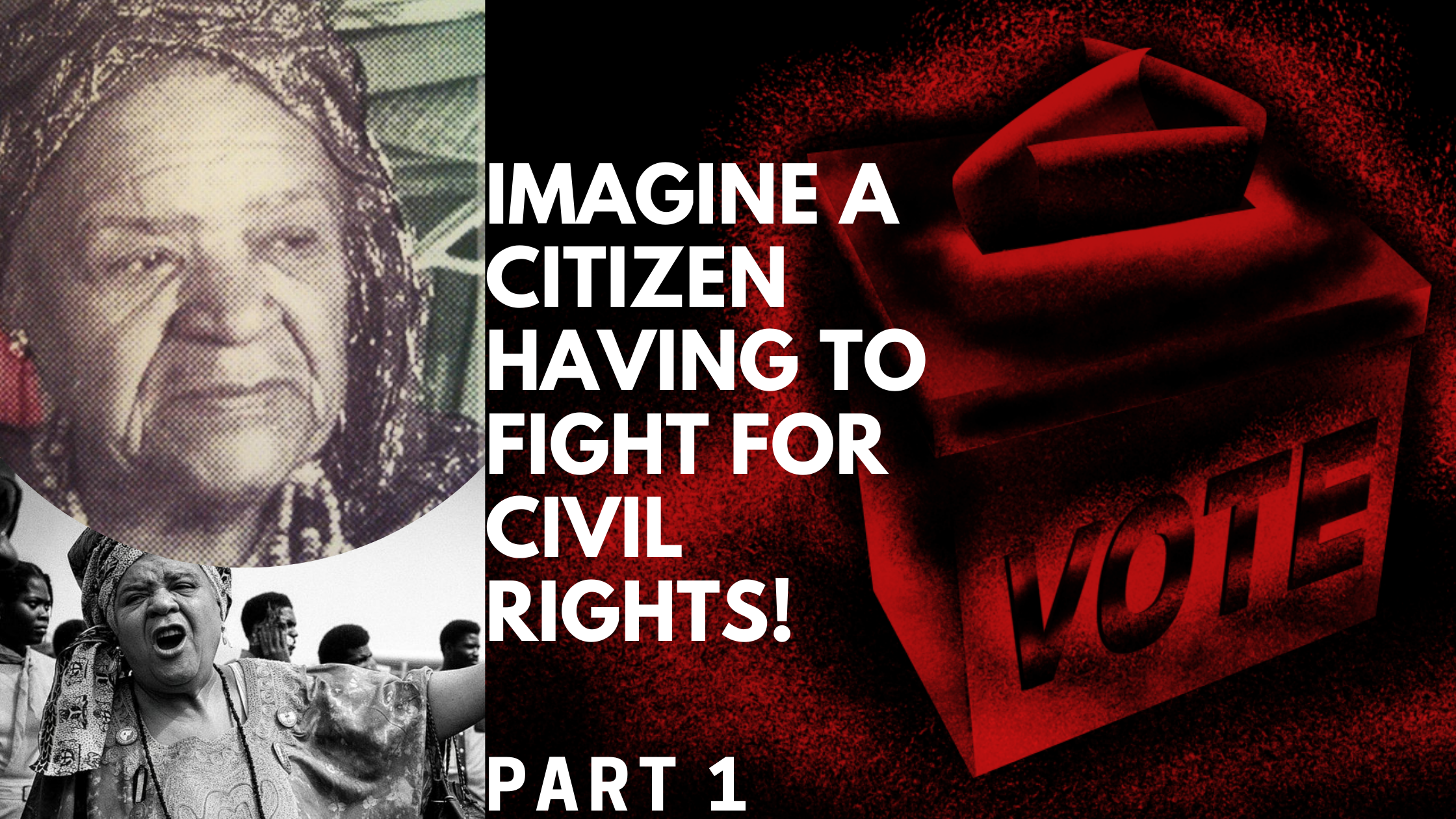
“We began to talk about wanting to be first-class citizens. We didn't want to be second-class citizens. You would have sworn that second class was in the constitution. Also that citizens have to fight for their rights. Imagine a citizen having to fight for civil rights! The very thought of it is repulsive. And I resent it, and I reject this "citizenship" that was imposed on me. From the bottom of my heart, I reject it.”
“I knew that there was no land in the world called Negro land and that in analyzing all of the histories of the other peoples, they all came from land. And those who robbed land, as soon as they robbed land, they changed the name of the land and then named themselves after the new changed name of the land. So even these people here who you all call Americans, this is not America.”
In addition to a heightened consciousness regarding her racial and class identity through her time with UNIA and the CP, Moore began to include colonialism in her analysis of society. With a newfound knowledge of the role colonialism played in establishing the United States, Moore concluded that race and racism were colonial mechanisms to develop hierarchical social structures that kept Europeans in power; she deduced that African-Americans existed in the United States as a “captive people.” Drawing parallels between colonialism in the Global South and the Black experience in the U.S., Moore concluded that self-determination was paramount to Black liberation and began exploring tangible ways to achieve it. While researching, Moore learned about the concept of reparations and discovered that the statute of limitations demanding reparations was rapidly approaching. According to historian Ashley Farmer, this prompted her to develop a reparationist politics that insists the only way upend the racist social and economic order was through substantial financial compensation. She would later incorporate this reparationist framework into the larger Black nationalist ideology she developed.
Over her decades-long career, Moore founded and co-founded several organizations to fight oppression and liberate African Americans. Although her call to reject American citizenship was an anomaly, the unique approach of subverting oppressive American institutions by critiquing the efficacy of striving for first-class citizenship inspired a movement that aimed to “decolonize and de-negroize” African Americans. One of those organizations galvanized a movement that has survived well into the contemporary moment. The Republic of New Africa (RNA) resulted from the Black Government Convention on March 31, 1968, in Detroit, Michigan. Over five hundred activists attended the convention, and after the event, dozens of attendees, including Moore, signed a declaration of independence that proclaimed a struggle for statehood for a liberated Black Nation. The resolution to strive for an independent Black Nation gave birth to a movement called the New Afrikan Independence Movement (NAIM) that involved several organizations with the goal of Black independence. Queen Mother Moore was the first to sign the declaration and proclaimed, “Hallelujah, Hallelujah! I’ve lived to see the day!”
Nearly sixteen years after the audacious declaration of independence made by the attendees of the Black Government Convention, the RNA split. On May 19, 1984, the New Afrikan People’s Organization (NAPO) was founded by Alajo Adegbalola, Dara Abubakari, and Chokwe Lumumba. Lumumba was appointed as the organization's first president. The RNA was a political organization and a political objective, and the NAPO members remained committed to achieving sovereignty. However, members of the nascent organization decided that a new approach to achieving their goals was necessary. The RNA was structured as a provisional government and focused primarily on gaining international recognition and serving as the government's administrative arm. Although this structure would be necessary to achieve nationhood, it is limited in its capacity to gain mass support from African-American communities nationwide. The NAPO activists sought to establish an organization created to engage with Black communities at the grassroots level by engaging in local campaigns and building coalitions with other grassroots organizations with similar political objectives and principles. In the NAPO’s founding document, the leadership stated, “these elements share a common strategic objective: that objective being self-determination, land and an independent nation-state for New Afrikans colonized by U.S. Imperialism.”
Another issue that resulted in an organizational split stemmed from differences in opinion about how NAIM and the RNA should move forward in achieving their political objective of a Black nation-state. Lumumba and the NAPO were outwardly and explicitly committed to “the creation of a New Afrikan socialist economy” for the RNA. Additionally, due to the federal government's ambivalent attitude toward the demands of Black activists, Lumumba and his supporters concluded that the only way to see significant progress toward their political objectives was through a “People’s War.” A profile of the NAPO described the People’s War as a multi-pronged assault on oppressive institutions. Although this movement did suggest the possibility of armed confrontation, they listed protests, rebellions, boycotts, and strikes as the initial tactics to achieve their political goals. Conversely, the RNA concluded that the best strategy for establishing a Black nation-state was to appeal to the United Nations for recognition and to seek support from countries they believed would be sympathetic to a movement for Black self-determination.
Despite a more militant orientation than the RNA and most African-Americans engaged in American politics, one could argue that Lumumba and the NAPO were among the more materially successful organizations to emerge from the NAIM. For nearly three decades, Lumumba and the NAPO transformed themselves into an organization that became a practical alternative to the Republican and Democratic Parties for Black voters. On June 4, 2013, Lumumba was elected Mayor of Jackson, Mississippi, on a politically progressive platform that could make the NAPO's lofty political objective of Black self-determination and economic autonomy a reality, even if only in the relatively small city of Jackson.
Defining terms for conceptual clarity
The eclectic nature of Queen Mother Moore’s politics requires a clear articulation of the terms and ideological frameworks at the heart of this project. Terms like Black nationalism, colonialism, and self-determination carry many meanings, respectively, and this essay requires specificity for a sound argument. Black nationalist thought in the US dates back to the mid-nineteenth century. However, according to historian Russell Rickford, questions regarding land sovereignty were revitalized in Black political discourse in the mid-twentieth century with the rise of activists such as Malcolm X and Kwame Ture and the decolonial struggles around the world. Sociologist Robert Allen posits that the tendency for Black-led political movements to gravitate towards nationalism is “rooted in the Afro-American’s experience of being forcibly excluded from and rejected by a society which is usually overtly, and always covertly, racist and exploitative.” For post-Civil Rights era activists, Black nationalism represented an effort to achieve socioeconomic equality. It addressed what they felt were shortcomings of milestone victories such as the Voting Rights Act of 1965 and the Civil Rights Act of 1964.
Historian John Bracey provided a broad definition of Black nationalism as “a body of social thought, attitudes, and actions ranging from the simplest expressions of ethnocentrism and racial solidarity to the comprehensive and sophisticated ideologies of Pan-Negroism or Pan-Africanism.” This broad definition could explain why Black nationalism attracted camps across the political spectrum. Political scientist Errol Henderson argues that the nebulous nature of Black nationalism is due to the contradicting “dualities both as a concept and as a specific program for Black liberation.” These dualities exist in the statist and non-statist, emigrationist and non-emigrationist, and Afrocentric and Eurocentric cultural definitions of Black nationalism. The orientation of nationalist formations' political objectives has often been determined by whether leaders pursued a radical transformation of the socioeconomic order or simply opposed the oppressive system’s leaders and sought to replace them. Queen Mother Moore’s assessment of the Black condition in the US led her to pursue the former, and she was instrumental in laying the groundwork for a specific, statist, non-emigrationist, and Afrocentric strain of Black nationalism that was informed by Marxist methods of analysis, dialectical and historical materialism, and anti-capitalism.
This specific strain of Black nationalism is commonly referred to as revolutionary nationalism, and in the case of the NAIM, their political objective was self-determination and economic self-sufficiency. Their primary strategy for addressing racist oppression is by establishing independent political and economic institutions that prioritize the material needs of working-class and African Americans. However, revolutionary nationalism is also a broad umbrella. The various contingents under this umbrella can generally be characterized by which institutions they target in their political programs, whether political, economic, or social. Nevertheless, they all conclude that a radical social transformation is necessary. Revolutionary Nationalists such as Queen Mother Audley Moore, Imari Obadele, and Chokwe Lumumba have argued their case for a statist, non-emigrationist, and Afrocentric political platform, declaring that African-Americans constitute a domestic colony of the United States.
Leaders within the NAIM sought support for their nationalist ambitions by developing political, economic, and social networks with anticolonial nationalist leaders such as Muammar al-Qaddafi of Libya, Tanzanian President Julius Nyerere, and the Sandinista government of Nicaragua. These connections were meaningful because they indicated they viewed themselves as part of a Global South-led effort to create a more equitable international community. As activist and writer Jack O’Dell expresses, these ties were not simply based on “the bonds of color” but on the shared experience of colonial domination. O’Dell argues that for African Americans, institutionalized slavery and racism “shaped this bond of identification” with anticolonial movements happening throughout the colonized world. In fact, he calls racism “the chief ideology of colonialism.”
The tendency to view African Americans as colonial subjects is informed by the internal colonialism debate. In short, internal colonialism is when uneven economic development impacts specific groups of people due to systematic exploitation and exclusion, which ultimately leads to economic and political underdevelopment within a state. The internal colonialism debate coincided with the development of Black nationalism and similarly became popular again in Black political discourse during the Black Power era. The idea that African-Americans existed as colonized people within the socioeconomic and political structures of the United States was argued most articulately by communist activist and writer Jack O’Dell. O’Dell argues that a major misconception about American history is that the US is fundamentally anti-colonial because the American Revolution was against British colonialism. However, that is not the case: “The decolonization of the American mainland achieved by the Revolution of 1776, which at the same time left the institution of slavery intact, meant that the African population in America remained a colonized people.” The colonial mechanisms left in place after the American Revolution vindicated the social psychology of power relations, perpetuating slavery and the infrastructure upon which the US was built.
Robert Allen suggests that the fact that African-Americans exist as a “semicolonial” is the “basic premise upon which an interpretation of Black history can be constructed.” Allen argues that the reformist policies borne of the Civil Rights Movement fell short because white and Black activists refused to acknowledge the parallels between the conditions of Black communities and colonized nations in the global south, and “the social structure simply cannot accommodate those at the bottom of the economic ladder.” Social and political reform fell short when addressing systemic racism because they failed to acknowledge the economic motivations that buttressed oppressive hierarchies based on gender, race, and class. The continued relegation of African-Americans to primarily unskilled labor after the ratification of the Thirteenth Amendment maintained a colonial economic order that required a permanent pool of cheap labor to thrive. According to Allen, emphasizing social and political inclusion decoupled from a drastic economic restructuring of the US has resulted in Black America evolving from a domestic colony to a neocolonial nation. Despite African-Americans' substantial political gains in the last several decades, they are still “subject to the will and domination of white America” due to continued economic domination and exploitation.
Social critic and scholar Harold Cruse argues that the only difference between African-Americans and traditional colonial subjects is that African-Americans exist in the metropole “in close proximity to the dominant racial group.” He argues that, despite formerly enslaved Africans being made citizens according to the law, African-Americans were only elevated to “semi-dependent” individuals. They remained on unequal footing with their white counterparts. Cruse concludes that in this context, the rise of Black nationalist movements throughout American history is a natural evolution of collective political consciousness amongst African-Americans.
O’Dell urged individuals and organizations involved in the Black Freedom Movement of the twentieth century to fully grasp the complexities of colonialism and recognize that a people can be colonized even if they have lived within a territory or nation for several generations.
The colonial problem is more than the annexation of foreign lands; it is “the role of the institutional mechanisms of colonial domination which are decisive.” The institutional mechanism was a system of restrictions in response to the gains African Americans made during Reconstruction. The withdrawal of Union soldiers from the deep south left African-Americans vulnerable to racial terror and intimidation from white supremacist organizations such as the Ku Klux Klan. This was followed by the expropriation of land by the former planter class. The Special Field Order 15 of January 1865, issued by Union General William T. Sherman, was intended to mitigate some of the damage done by slavery while simultaneously compensating Black Union soldiers for their service. Coupled with the Confiscation Act of 1861, the field order was supposed to redistribute the land of former plantation owners to emancipated slaves so they could cripple the planter class and make Black people self-sufficient. However, President Andrew Johnson stonewalled the legislation and returned the land to the treasonous Confederate plantation owners. Additionally, forced labor was codified into law by making involuntary servitude legal if convicted of a crime. The passage of the Black Codes made it easier to ensure that those forced into slavery were black. Landless, vulnerable to white supremacist violence and intimidation, Poll Taxes compounded with the ratification of Jim Crow laws ensured the reconsolidation of white supremacist, colonial power bases in the south that could act on behalf of the political interests of the old planter-class.
Enslaved Africans and their descendants were forcibly removed from their established homelands in the African continent, where they had their own complex social and political, and social structures that informed their existence and knowledge of self. They were then thrust into a society that was not only alien but antithetical to their way of life in Africa. Despite their labor being necessary for the development of American culture, they were systematically and “forcibly excluded from participation by a system of mechanisms established by those who owned the land and other means of production in the new territory.” In this context, the US merely replaced the British as colonial masters of North America, and the revolution was incomplete. The revolution was incomplete because there was no socioeconomic transformation of society, as the institution of slavery persisted for nearly a century after the declaration of independence; instead, the American Revolution was ultimately just a transfer of political and economic power from the British to American settlers. To remedy this problem, O’Dell suggests drafting legislation for a New Reconstruction to transform “the economic, cultural, political, ethical, and institutional fabric of American life.”
Political discourse concerning internal colonialism for African Americans and its influence on revolutionary Black nationalism raises several questions about its efficacy in the contemporary moment. Since the end of de jure segregation, African Americans have been able to occupy the most powerful political positions in the United States. Do African Americans still exist as colonial subjects as the once-rigid boundaries of the racial hierarchy in the United States appear to soften? Although African-Americans now have access to the most powerful political positions, the impact of the institutional colonial mechanisms described by O’Dell is still prevalent in African-American communities across the United States. Additionally, as Cruse argues, Black people who do gain access to positions of power more often than not are still beholden to the interests of the dominant, white supremacist order.
Queen Mother Audley Moore was an essential figure for the evolution of Black nationalism into a framework that was attractive to some of the most radical and militant participants in the Black Freedom Struggle in the twentieth century. However, Chokwe Lumumba and the NAPO advanced revolutionary Black nationalism into a framework that could be widely accepted by people who do not identify as nationalists but still advanced economic and political autonomy and self-sufficiency. Moore’s career involved work in grassroots and electoral political campaigns, and she was directly involved in several watershed moments in Black history throughout the twentieth century. She was in conversation with or a mentor to some of the most influential thinkers and activists of the Black Freedom Struggle, such as Harry Haywood, Malcolm X, Muhammad Ahmad, Imari Obadele, and Chokwe Lumumba.
The establishment of the RNA and later the NAPO marks a point of divergence from conventional political thinking in both the Civil Rights (CRM) and Black Power Movements (BPM), respectively. The BPM was distinct from the Civil Rights Movement because it rejected the widely held presumption that support from white liberals was necessary to build a sustainable mass movement for Black liberation. According to Kwame Ture and Charles Hamilton, one of the primary objectives of Black Power was ultimately more equitable representation at all levels of government. However, Black Power carried many different meanings for African Americans. Land became a central question among activists and theorists after Malcolm X declared, “Land is the basis of all independence. Land is the basis of freedom, justice, and equality.” For former Massachusetts Senator Edward Brooke, Black Power meant economic uplift through Black capitalism. What distinguishes NAIM from the preceding social justice movements is its emphasis on self-determination and economic autonomy on the road to an independent Black nation-state. The intellectual evolution of Moore’s nationalist, socialist, and Pan-African political framework shifted from seeking to improve the United States’ liberal democracy to a commitment to break away from it entirely in favor of Black nationhood.
Predatory Inclusion and other tools of democracy
As election cycles come and go, the political fervor of working-class African-Americans is regularly absorbed by the same political parties responsible for drafting legislation that perpetuates Black subjugation. At the same time, the nation is seeing more Black people in the most powerful positions at the federal level. For the first time, a Black woman sits on the Supreme Court, Ketanji Brown-Jackson. The country came as close as it has ever been to electing a Black woman to the White House with Kamala Harris. The current House Minority leader for the Democratic Party is Hakeem Jeffries, a Black man. If one understands one of the primary objectives of the CRM and the BPM as more government representation, one could strongly argue that those objectives have been met. However, as the police state strengthens with projects like the 1033 program, the wealth gap widens, and imperialist initiatives in Africa, such as AFRICOM, expand, one could argue that the state of affairs for African Americans and the rest of the diaspora has not improved substantially enough to say the fight against oppression has been won. In this context, social justice movements must demand more than identity-based representation in government as the solution to mitigate the diverse forms of harm and violence inflicted upon oppressed communities and establish organizations beholden to the interests of the working-class.
Centering movements on the acquisition of first-class citizenship and racial equality has created the conditions for what scholar Keeanga-Yamahtta Taylor calls “predatory inclusion.” The rights and privileges African-Americans believed would be afforded to them after integrating social, economic, and political institutions have been profoundly limited. Taylor argues these “tools of democracy” were “fundamentally distorted by racism.” Consolidating a movement grounded in the material reality of the shared experience of colonial or neo-colonial domination, rather than in the pursuit of an elusive first-class citizenship, would provide scholars and activists with the tools necessary to formulate objectives that go beyond the limits of the dominant political order.