
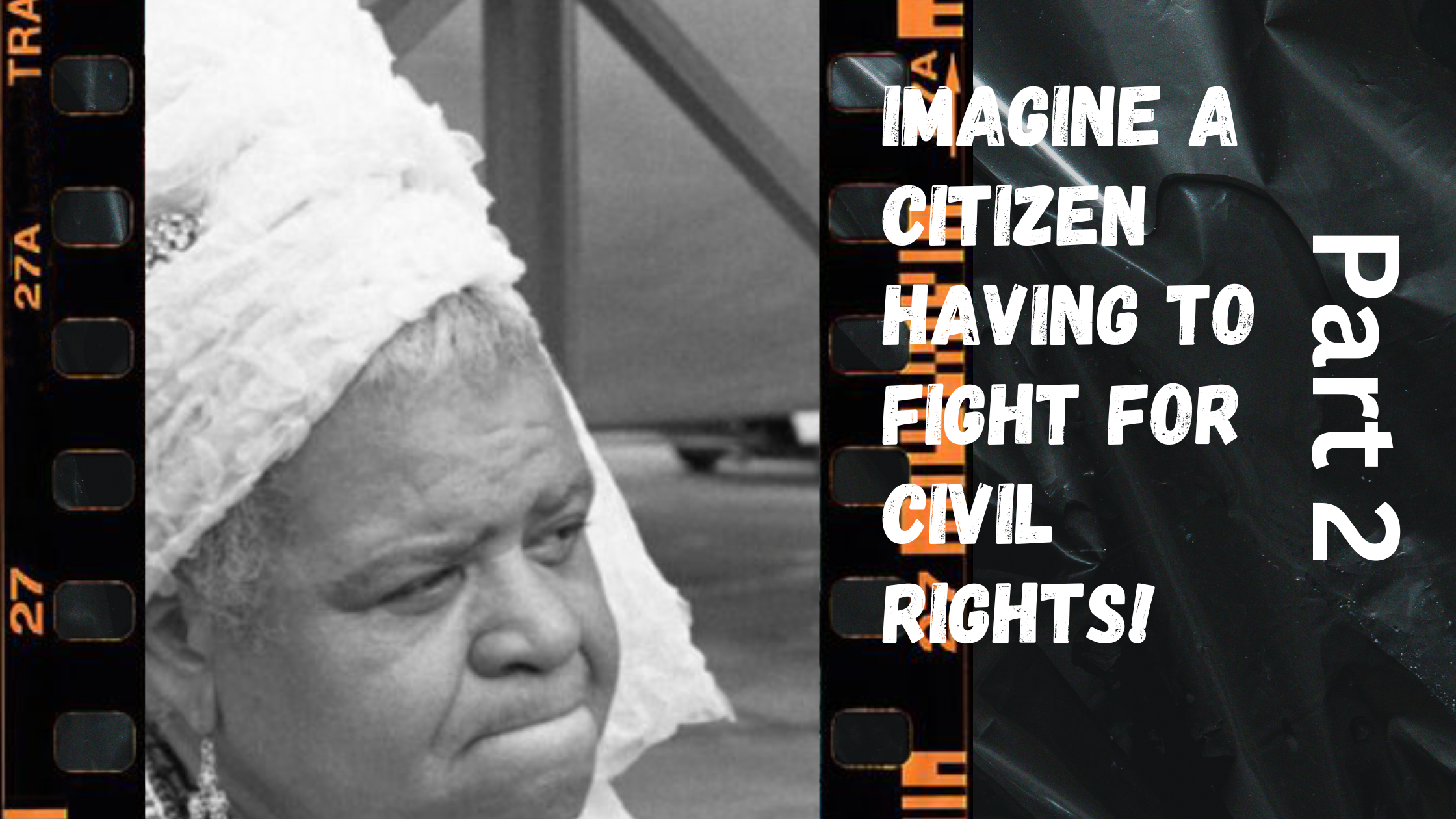
-Broderick Dunlap
January 9, 2026
Part 2:
The Political Career and Influence of Queen Mother Audley Moore
Spanning five decades, Queen Mother Moore’s experiences from New Iberia to Harlem, to Philadelphia, reveal a constant adjustment in tactics and political frameworks to achieve her objective of Black Liberation. Her experiences led her to no longer petition for inclusion in the American political economy; she pointed out the contradiction of a citizen advocating for rights that were, in fact, a birthright and chose revolutionary nationalism instead. Moore’s trajectory from Garveyite to Communist to reparations architect maps out a political education informed by trial and error and a refusal to settle for the limited possibilities of liberal democracy as a vehicle for Black liberation.
Audley Moore was born to Ella Henry and St. Cyr Moore on July 27, 1898, in New Iberia, Louisiana. Moore was the oldest of three children; her mother died during the birth of her fourth child when she was five years old. A decade later, when her father, St. Cyr, passed away, Moore assumed the role of caretaker for her two younger sisters. Moore became an activist at a young age and was initially inspired to action by her sister, Eloise. During World War I, Audley and Eloise recognized the lack of care and resources given to Black soldiers compared to white soldiers. After garnering support from the women in their neighborhood, they provided Black soldiers with coffee and other provisions as they prepared for deployment. According to Moore, her sister, Eloise, found an abandoned church and used the space to provide Black soldiers with a place to relax and socialize. This moment was pivotal for Moore and “set the precedent for the sisters’ involvement in any movements and groups that united Black people toward the goal of regaining their ‘right minds’”
By 1919, Moore married Frank Warner and moved to New Orleans, Louisiana, where she was introduced to Marcus Garvey’s Black nationalist movement and became a member of his Universal Negro Improvement Association (UNIA). In her interview with Gilkes, she recalled participating in a protest that had over 3,500 armed community members to defend Garvey’s right to speak publicly in New Orleans. “Everybody went, determined that the police won’t stop him tonight… So we all had guns, everybody had guns and a suitcase of ammunition.” According to Moore, the New Orleans Police were the primary objectors to Garvey’s scheduled visit. Despite objections from law enforcement, Moore and her comrades refused to be intimidated and concluded that the only way to defend their rights was through a show of force and a willingness to defend themselves. Although militant non-violence was a popular method of resistance in the Civil Rights Movement, she saw the practicality of self-defense when unmitigated racial terror was the norm. Moore identifies her encounter with Garvey and her time in UNIA as a personal and political awakening. She began studying the history of Africa and the diaspora, which stirred up feelings of racial pride. A newfound sense of racial pride meant that Moore and her husband could no longer tolerate the overt racism prevalent in Louisiana. In just three short years, Moore and her husband moved from New Orleans to Los Angeles, Chicago, and finally landed in Harlem, New York, in 1922.
Moore arrived in New York amid the Harlem Renaissance, and Black artists were at the forefront of a cultural transformation in the United States. In their search for a haven for Black people, Harlem was depicted as somewhat of a utopia to Moore and her husband. Unfortunately, when Moore initially arrived, she painted a picture that contradicts what had been described to her: “I never was so disappointed in my life as I was when I came to New York.” The atmosphere of the city felt “almost just like slavery.” The material conditions of Black New Yorkers left Moore dismayed, and she was told by a friend that “the only way you can change these conditions is to get into politics.” She was initially advised to join the Democratic Party. However, she spurned that counsel because she recalled her father telling her about what the Democrats did to overthrow the Republicans in the South during Reconstruction and the unscrupulous methods they used to trick Black voters into voting for them. With this in mind, she decided to join the Republican Party instead. Her time at the party, however, was short-lived. After working on the successful election campaign for J. Falmouth Steele, a Black man, she thought she would see progress for Black New Yorkers. That was not the case; after the campaign workers told her there would be a segregated victory reception, she said, “What is this I’ve gotten myself into? I may as well have been a Democrat.”
Despite being disillusioned by her experience with electoral politics, her commitment to the fight against racial oppression was unwavering. Shortly after the campaign, her sister informed her of a Harlem protest in support of the Scottsboro boys. The Scottsboro Boys were nine Black boys falsely accused of raping two white women in a train car in Scottsboro, Alabama. The initial case lasted only two weeks, and all but the youngest boy, who was thirteen years old, were sentenced to death. Leroy Wright, the youngest of the group, was sentenced to life in prison. At first, Moore was taken aback by the militant signage of the protest, “Free the Scottsboro Boys,” “End Jim Crow,” and “Death to Lynchers.” Former vice-presidential candidate for the Communist Party, James Ford, was a keynote speaker at the protest.
Ford discussed imperialism in Africa, their support for anti-lynching, civil rights, and voters’ rights bills, and how the CP was part of a global working-class movement against oppression. She found the CP platform more attractive than the Republican and Democratic parties. She thought it would be a “wonderful vehicle” for Black liberation. Moore soon became active in communist organizing spaces, and by 1930, she was a full member of the party. Moore’s time in the CP represented another political awakening for her. She credits her time in the CP for helping her develop the “discipline of the movement,” where she learned of historical and dialectical materialism and what she called the “science of society.” Dialectical materialism helped Moore understand the social forces at play in historical political events, and she learned that most conflicts throughout history were motivated by the material needs of the actors involved.
Although she gives the CP significant credit for being a catalyst in her political development, she had some strong critiques of the party as well. Her principal concern was the rampant racism within the organization. While the party at large was substantially more progressive than the Democrats and Republicans, the CP had “racists by the score, racists, full of racism.” Another major critique she had was that the CP rejected the notion that Black people constituted a nation. She credits activist Harry Haywood for initially formulating the idea of Black nationhood, but also states that she “was already questioning the term Negro” and had been in conversation with him before he disseminated his ideas.
Moore’s time in the CP helped her develop a deep understanding of capitalism and to apply dialectical materialism to examine how the economic system shaped society at large. However, she realized that the racism within the CP created conditions too hostile to be the “wonderful vehicle” she initially thought it could be when she decided to join two decades earlier. The CP’s class analysis and militant opposition to racial oppression were what initially attracted Moore to the party; however, their refusal to consider the intrinsic ties race and racism have to colonialism and their relationship to capitalism in the United States left Moore questioning their ability to combat racism adequately. Despite the CP’s shortcomings, she did not abandon the anti-capitalist principles of Marxist thought as she continued her political career.
In 1954, Moore returned to New Orleans to handle her half-brother’s affairs after his death, but that did not hinder her from organizing. Shortly after her return to New Orleans, she founded the Universal Association of Ethiopian Women (UAEW). The Black nationalist and communist political orientation the activist developed during her time in the UNIA and CP is evident due to the campaigns the UAEW rallied around. Moore established the UAEW to “uplift and inspire” the local Black community and “organized poor and working-class African American women based on their historic and present-day connections to the slave trade.” Moore was committed to organizing wherever Black people were, and she concluded that the church was one of those places. Moore gained positions of leadership in several congregations and denominations and used her social status as a clergyperson to gain access to prisons and advocate for incarcerated Black people. From 1957 to 1960, the UAEW advocated against the death penalty and championed appeals to the United Nations for Black women to receive state aid. Due to the Suitable Home Law, a piece of legislation that banned women from receiving aid if they “did not conform to white standards of motherhood and domesticity.” Black women in Louisiana were arbitrarily excluded from government assistance.
The appeals to the international community for Black women to receive aid from the state inspired Moore and the UAEW to investigate all other forms of redress owed to African Americans. During their research, they came across an excerpt that would significantly shift the organization’s political goals. In an interview with The Black Scholar, Moore recounts discovering the quotation:
“We saw in an old encyclopedia, Presbyterian or something, that those who find themselves captives and do not place before their captors a judicial demand for their liberation within a hundred years are considered satisfied and belong to their captors. The statute of limitations goes into effect. We went to work when we saw that.”
According to the vice president of the UAEW, Dara Abubakari, after finding this excerpt, they began a “campaign to encourage African Americans to file a formal reparations claim with the US government before the centennial anniversary of the Emancipation Proclamation in 1963.” Historian Ashley Farmer posits that Moore formulated a form of “reparationist politics” that posits that one of the only acceptable means for rectifying the atrocities committed during the middle passage, slavery, and Jim Crow is “extensive economic restitution.”
Queen Mother Audley Moore moved to Philadelphia with her sisters in 1962 and established the Reparations Committee of Descendants of United Slaves Slaves Inc. The primary objective of the Committee was to formulate demands for financial compensation from the federal government for slavery and Jim Crow. The following year, Moore wrote Why Reparations? Reparations is the Battle Cry for the Economic and Social Freedom of More than 25 Million Descendants of American Slaves. Why Reparations? which was one of the first major theoretical works on reparations that demanded substantial financial compensation for chattel slavery. One of the principal demands listed sought “money damages for the victims of these injustices with which to begin a program of rehabilitation.” In addition to the atrocities African Americans endured during the Trans-Atlantic Slave Period, Moore asserts that the justification for reparations extends far beyond slavery. The activist also listed lynching, rape, Jim Crow, and disenfranchisement as significant violations of the human rights of African Americans.
Moore also expressed serious concerns about the CRM and suggested that it would fall short of its goal of equality if it did not call for significant economic restitution in addition to its demands for political empowerment and social inclusion. Moore and the reparations Committee argued that the March on Washington on August 28, 1963, was an anti-climax to the mass mobilizations that led up to the historic march and suggested that it was a disappointment because they did not foreground reparations as a central political demand of the March’s platform. in Why Reparations? Moore begins to articulate the theoretical underpinnings of her reparationist politics:
“The fact that reparations have not yet been included along with the integrationist leaders’ demands is because they underestimated the depth and the bitterness of our suffering and the intelligence of our people… Without Reparations, our people can never be on equal terms with the white sons of our former slave masters who continue to reap the abundant benefits of the wealth created by our foreparents through their centuries of unrequited labor.”
While the United States was rapidly becoming a world power, African Americans were barred from economic and political participation. In, Why Reparations? The activist posits that the high poverty levels in Black communities are a direct result of chattel slavery. Moore and the Reparations Committee surmised that “the payment of Reparations is an absolute necessity if the Government of the United States is ever to wipe the slate clean.” Moore goes further and contends that it is the duty of every “well-meaning and patriotic American to help this long overdue and just effort to erase the blot and stigma from the unfortunate past of America’s history.” The creation of this reparationst political framework seemed to be the perfect vehicle for combating racism that Moore had been searching for since her days in the CP. In concert with the preexisting Black nationalist and communist principles she had developed through decades of political struggle, Moore began to make headway in her journey to find a political framework she felt was adequate to address all forms of oppression and violence affecting African Americans.
Moore recalled that she and her sister, Eloise, were the ones responsible for politicizing Malcolm X: “Eloise trained Malcolm… it wasn’t Elijah.” According to the activist, “Malcolm didn’t know nothing about Africa,” and it was Moore and her sister who helped the Muslim minister “get a new insight” regarding race. The sisters also got Malcolm X to set up a meeting with Nation of Islam (NOI) leader Elijah Muhammad in an effort to convince him to take the NOI in a more political direction, but “he didn’t want to hear nothing about Africa.” Despite the mixed reception she received from her peers regarding Black nationalism, Moore persisted in her journey to find answers to her questions regarding Black liberation.
Queen Mother Moore had been organizing for several decades by the time the BPM began to take shape, and her work was already well known amongst Black Power activists. Shortly after Moore moved to Philadelphia in 1962, she began to mentor young activists in the area. She was influential in the Marxist and Black nationalist orientation of the Revolutionary Action Movement (RAM). Founder of RAM, Muhammad Ahmad (formerly known as Max Stanford), credits Queen Mother Moore with the group’s decision to make reparations demands one of the organization’s primary objectives and with adopting a Marxist-Leninist political orientation. The organization was also the first and only secular political organization Malcolm X joined after leaving the Nation of Islam.
The BPM coincided with a period of decolonization in Africa, which significantly influenced grassroots activists’ political aspirations and objectives. Instead of fighting for the right to vote or integration, many activists prioritized self-determination as their political objective. Colonialism and its impact on African-Americans began to be taken more seriously amongst those involved in the Black Freedom Struggle, and Moore’s ideas concerning Black nationhood were no longer dismissed. Still, they were being engaged vigorously by young activists. In October of 1968, in Detroit, Michigan, a place once considered a graveyard for Black communists, the Republic of New Afrika was founded. The result of the Black Government Convention, organized by former students of Malcolm X, Gaidi, and Imari Obadele, was that over five hundred activists from across the country converged on Detroit to discuss Black nationhood and how to achieve it. Although the Obadele brothers were the initial leaders of the organization, Moore played no small part in the founding of the RNA: “Honey, I wasn’t involved, I initiated it.”
Despite RNA being the first organization to take her ideas about Black nationhood seriously, she still received critiques. When she presented the idea that African-Americans constitute a nation, she was saying that, assuming they understood that this would be a long-term goal that would take at least ten years to accomplish. However, the leadership in the RNA was imprudent in their plan to make an independent Black nation-state a reality. They began electing people to positions and establishing embassies before having an internationally recognized national territory or any of the resources or infrastructure needed to establish a nation. Moore recommended a plan of “agitation, preparation, and organization” to take steps toward nationhood; instead, they took her idea “ill-prepared, ill-equipped, and they ran away with it.” Moore’s critique of the RNA’s ambitious endeavor to establish a nation was apt. Although Moore was an enthusiastic endorser of the RNA’s declaration of nationhood, she was wary of the lack of mass support necessary to make their declaration a feasible reality.
The Republic of New Afrika
Despite Moore’s critiques of the RNA, one could argue that they were the closest to materializing the political framework she had spent decades developing at the time. The RNA viewed reparations as a vehicle for economic and political self-determination by acquiring land and resources to develop the land. They also cultivated a distinctive “New Afrikan” identity that rejected Eurocentric political, socioeconomic, and cultural practices. According to the RNA, those who identified as New Afrikan both embraced their African heritage and acknowledged the centuries of enslavement of Africans. They also believed that relinquishing the second-class status that comes with American citizenship for Black people lays bare the reality that African Americans still exist as colonized subjects. In addition to Moore’s ideas regarding Black nationhood, they also gleaned from the political frameworks for nation-building conceptualized by Julius Nyerere and the Tanganyika African National Union (TANU), they subscribed to Ujamaa, a form of African socialism.
Tanzanian President Julius Nyerere promoted Ujamaa. In a 1962 pamphlet titled “Ujamaa―The Basis of African Socialism,” Nyerere articulated his conceptions of this unique form of African socialism and explained how it differed from other forms of socialism:
“Socialism – like democracy – is an attitude of mind… and not the rigid adherence to a standard political pattern, which is needed to ensure that the people care for each other’s welfare. Ujamaa is opposed to capitalism, which seeks to build a happy society on the basis of the exploitation of man by man; and it is equally opposed to doctrinaire socialism, which seeks to build its happy society on a philosophy of inevitable conflict between man and man. We, in Africa, have no more need of being ‘converted’ to socialism than we have of being ‘taught’ democracy. Both are rooted in our own past – in the traditional society which produced us. Modern African socialism can draw from its traditional heritage the recognition of ‘society’ as an extension of the basic family within the limits of the tribe, nor, indeed, of the nation.”
Embracing a socialist economic model characterized explicitly as culturally, ethically, and socially African was complementary to the imagined political framework that subscribed to a communist philosophy. The founding activists of RNA concluded that capitalism and colonialism are intrinsically linked, and it was not enough to embrace an African cultural and political identity. Still, it was also imperative to develop an alternative mode of production that was non-hierarchical and non-exploitative. They considered Louisiana, Mississippi, Alabama, Georgia, and South Carolina as potential national territory due to the dense Black population and the potential to build a substantial power base for their political objective. Moore and leaders of the RNA decided that the best way to address the vestiges of slavery that impacted African Americans was through building a democratic economy to achieve collective uplift.
By the time Queen Mother Moore declared, “I reject this ‘citizenship’ that was imposed on me. From the bottom of my heart, I reject it.” She had spent decades searching for the appropriate vehicle for social transformation to eradicate all forms of oppression. From the grassroots to the federal level, organizing a movement that emphasized assimilation, integration, and first-class citizenship resulted in disappointment. From Moore’s perspective, she wasn’t missing out on much by rejecting her American citizenship. It only represented subjugation, exploitation, and the constant threat of colonial violence for her and her people. The RNA reached a similar conclusion regarding American citizenship and its meaning for African-Americans. According to historian Edward Onaci, declaring citizenship of the RNA “empowered activists to rethink their relationship with the United States and with other oppressed peoples around the world.” Instead of seeking first-class citizenship, activists in the RNA aligned themselves with the Global South, fighting colonialism and imperialism. New Afrikan activists also developed a legal argument that questioned the validity and legality of African-American citizenship immediately following emancipation.
New Afrikan activists argued that formerly enslaved Africans had citizenship forced on them when it should have been offered with the ratification of the Fourteenth Amendment, which states that “All persons born or naturalized in the United States, and subject to the jurisdiction thereof, are citizens of the United States and of the State wherein they reside.” In direct contradiction of the 1857 Dred Scott decision, which declared that African-Americans were not full citizens and therefore not protected by the Constitution, the Fourteenth Amendment effectively transformed enslaved Africans from three-fifths of human beings to full citizens of the United States of America. However, they argued that this was done without any involvement or consent from African Americans. New Afrikan activists argued that due to this imposed citizenship, Black people were entitled to an opportunity to decide whether or not they wanted to remain citizens of the US or choose another nation to pledge allegiance to.
The RNA also incorporated Moore’s reparationist economic framework to make their audacious plan for nationhood economically feasible, and they formulated a comprehensive policy proposal that justified reparations. Their work resulted from the “Anti-Depression Program”, a series of legislative requests with the goal “to end poverty, dependence, cultural malnutrition and promote inter-racial peace.” The program provided a plan for using the money, land, and other resources acquired through reparations. The Anti-Depression Program included a demand for the peaceful surrender of land and $300 billion in financial restitution for African Americans. The authors of the proposal relied heavily on historical precedent and legal interpretation to justify their demands.
New Afrikan activists argued that the history of slavery, racial terror, extreme exploitation, and oppression constituted acts of war against African-Americans. In the legislative request, the authors argued:
“The landless New Afrikan nation in America during the time of slavery arose from forced mingling of persons from several African subraces… This New African nation was subjected to warfare by the United States as brutal as any ever waged by people against another. New African manpower was destroyed during slavery under the white Americans nearly as systematically as Jewish manpower under the Nazis.”
The RNA activists’ reliance on the theoretical underpinnings of Black nationalism to frame African-Americans as a landless nation who had been victims of war crimes was central to their legal argument because reparations typically “involved payment from one nation to another for war damage.” The Anti-Depression chronicled several incidents when the U.S. government deployed its military to quash rebellions led by enslaved Africans. In 1831, Nat Turner’s rebellion was defeated by army troops. Nearly three decades later, the U.S. Marines vanquished an attempt led by John Brown in the 1859 battle at Harper’s Ferry, Virginia. The strict adherence to the Black Codes following major slave rebellions was framed as a military occupation of the New African nation. According to RNA leadership, attempts to establish independent communities were sabotaged and attacked by U.S. military forces, bounty hunters, and indigenous people employed by the US. For the RNA, these acts of war justified their demands for reparations in the form of land and substantial financial compensation. The RNA claimed this plan would directly impact and improve the lives of the entire African-American population in the US.
RNA activists believed the incredibly ambitious Anti-Depression Program was necessary to solve most of the problems African American communities throughout the country faced. For Obadele, this money was not for individual upward mobility but “would cover the tangible expenses such as relocating thousands of southbound families and creating an infrastructure to sustain the RNA’s ‘New Communities.’” Although the legislative requests within the Anti-Depression Program were never formally accepted, the program would serve as a blueprint for organizations that aimed to formulate comprehensive programs for not just reparations but community development.
The legislative request for the peaceful surrender of such a large swath of land from an empire with the resources of the US was imprudent. The New African activists relied heavily on historical precedent to justify their request for land and listed several examples of the US using treaties to expand its borders. “The Indians yielded much of their land as the result of treaties.” The authors of the legislative request stated that some of these treaties followed warfare and settler occupation. Nevertheless, the United States’ possessive sovereignty rested on the recognition of over 300 treaties, despite the US violating nearly all agreements with Indigenous nations. However, the treaty they sought to draft would have annexed land and shrunk the United States’ national territory, and there was no precedent for such an annexation. Much like the militant nonviolent activists of the Civil Rights Movement, they sought to appeal to the moral sensibilities of American lawmakers. Still, that strategy fell short in achieving their desired political objectives. Forfeiting five states for free did not represent any benefits for the US, politically or economically. For the US to seriously consider such an endeavor, the RNA would need to be a much more formidable political entity than it was when it drafted this legislation.
The demand for $300 billion in reparations was regarded as the solution to all the problems plaguing Black people. RNA leadership viewed lack of employment, access to housing and adequate healthcare, education, and the denial of economic or political power as the most pressing problems African Americans face. The legislative request for indemnification would serve as a stimulus package for the Black nation-state, simultaneously addressing unemployment, housing access, and economic power, and developing the infrastructure necessary for a self-sufficient and thriving country. The Program outlined a budget of $57.5 billion for the first two years. $35 billion was earmarked for the acquisition of land and the construction of 4,000 new communities explicitly built for Black families. $20 billion was dedicated to the “partial payment of reparations direct to descendants of slaves (the formula is $10,000 per descendant; $4,000 direct to the individual). $2.5 billion would go to assisting Black families to relocate to the new communities. The budget for the remaining funds would be decided through a series of democratic processes, including a plebiscite and a Congress of Commissioners elected by the citizens of the new nation-state.
While lawmakers didn’t consider the demand for reparations, the emphasis on community development and a democratically controlled economic system would prove to be a lasting objective for the RNA and, later, the NAPO. Despite the improbability of securing national territory, their attempt to implement alternative cultural and economic practices was generative. Eschewing the pursuit of elusive first-class citizenship helped stretch the political imagination of New Afrikan activists beyond the limits of liberal democracy. Subscribing to this statist, non-emigrationist, Afrocentric, reparationist political framework caused them to demand more than incremental reforms but a total transformation of the dominant political and economic order.
The ambitious endeavor to build a separatist movement within the borders of the United States meant New Afrikan activists quickly attracted the attention of local and federal law enforcement agencies. The extralegal activities of federally backed programs like the FBI’s Counter-Intelligence Program (COINTELPRO) resulted in violent clashes between law enforcement and Black Power and NAIM activists nationwide. In “Short History of the U.S. War on the RNA,” Chokwe Lumumba recounts the case of the RNA-11. On the night of August 17, 1971, there was a“full-scale military attack on the RNA Government residence” coordinated by the FBI in collaboration with the Jackson Police Department. The next day at 6:30 in the morning, law enforcement officers fired over three hundred rounds into the RNA office, where seven activists were asleep.
Fortunately, the activists escaped the barrage of bullets with their lives but were arrested in the aftermath. Two officers were wounded when RNA activists fired their weapons back in self-defense, and the Intelligence Squad Chief for the Jackson Police Department died. The attack on the RNA residence resulted in the arrest of Imari Obadele and three other activists. The eleven activists were beaten, chained, and paraded across Jackson by the police and charged with murder, assault, and waging war against the state of Mississippi. Despite questionable testimonies and evidence, all eleven activists were found guilty and ordered to terms ranging from three to seventeen years. Although ten of the eleven convicted activists were released within the following decade, efforts to keep the RNA-11 out of prison hindered the organization from pursuing its initial goal of building an autonomous Black community in the heart of the Black Belt. Ultimately, the goal of the attack on sleeping New Afrikan activists was achieved. The aftermath of the shootout forced the RNA to shift its focus to securing legal support for its incarcerated comrades instead of working to achieve its political objectives. In addition to hindering their movement, the arrest and incarceration of RNA president Imari Obadele resulted in a transfer of power to Alajo Adegbalola, Dara Abubakari, and Chokwe Lumumba.
Outside of its premature establishment as an independent nation-state, the Republic of New Afrika, as an organization, was the manifestation of everything Moore imagined a radical Black organization should be. In addition to stretching their political imaginations and rejecting the notion of first-class citizenship as a political objective, RNA activists believed embracing a New Afrikan identity would realign African-Americans with oppressed people throughout the global south who were ousting colonial powers at an unprecedented rate. Further, they championed an alternative, anti-capitalist mode of production to address the economic exploitation and deprivation prevalent in Black communities. Despite all this, the imprudent approach to establishing an independent Black nation-state was too large a hurdle to overcome. The lack of mass support for the RNA ultimately made their goal of establishing an independent Black nation-state an obscure camp within the Black Freedom Struggle.
Moore’s flexibility and willingness to adapt to the political landscape, from Garveyite racial pride, self-defense, and economic self-sufficiency to the Communist Party, and later, reparationist politics. Her influence taught later organizers that every shift in state policy required a new demand rooted in the material needs of working-class Black communities, and that those shifts needed to be addressed. The RNA internalized these lessons, framing land and compensation as non-negotiables for their plan of national liberation; the NAIM used the same adaptability to survive COINTELPRO and keep organizing across the country for decades after 500 activists gathered in Detroit to declare independence. Her insistence that the strategy adjust without abandoning the primary objective of self-determination influenced New Afrikan activists to test their hand in electoral politics to seize governmental power at the municipal level in the Deep South.